Showing posts with label Bergquist. Show all posts

Thursday, July 23, 2015

Life at RAFB before RHS

Jerry Ball was wondering about what things were like in the years before he arrived at RHS. Well, I had arrived myself in the fall of 1960, so maybe there is a story here.

In the fall of 1960, I was a freshman at Dover High School in Dover, DE. I had gone to school there with the same group of students since second grade, when we had arrived there from Hickam AFB, HI in 1953. At that time, the base was in the early stages of being re-activated after having been closed after the Second World War. There was no base housing so my folks had bought a Levittown-like house between Dover and the base for us to live in. Every single one of the houses in the subdivision was laid out the same; the only difference was that half had the front door on the right, half on the left.  My dad had been sent on a remote assignment to Dhahran, Saudi Arabia in 1959 and we stayed in Dover. When he got back with orders to transfer to Randolph, we packed up the family station wagon and hit the road. I had just finished my first six weeks in high school and was a totally sullen, rotten teenager who must have been the worst possible company in the long drive down to San Antonio.

When we got to Randolph, my dad found out that we could get base housing, but would have to wait a while. My folks looked around for a place and while searching, we stopped for lunch at the Old Bossy in Schertz. Me, being the rube that I was, looked at all the guys in there with their cool S-C letter jackets and wondered why so many University of Southern California students were in a small town in south Texas.
But my folks couldn't find a place and therefore rented a house in San Antonio, near the Austin Highway, while we waited for our base housing to be assigned. Since the house was in the Northeast Independent School District, my folks took me over to MacArthur High School to enroll me. But to my horror, a ninth grader in 1960-1961 was not a high school student and was instead enrolled in John Nance Garner Junior High. Garner was just one of the wings of what is now MacArthur High, but it was  junior high! I had had to leave everyone I had known to come to Texas and was now being sent back in social standing to junior high. I was not a happy soul,

But when we moved onto the base later that fall, things got a whole lot better. The first thing that was better was our wheels. The base had contracted with a charter bus company (I think it was Kerrville Bus Co.) to take us kids downtown to school at Garner/Mac. And the buses that carried us were not the cheese buses that everyone else had to ride. Oh, no, we were special. We were delivered to school in silver, Greyhound-like buses. I might have been the only one who thought it, but I was pretty sure that I was cool.

It seemed when we arrived in the fall of 1960 that base leadership was willing to provide transport to a variety of schools. Some went to Schertz, some to Central Catholic, some to Alamo Heights, and some to Mac. I don’t think anyone went to Judson. But in those years, Judson was a tiny school. Randolph eventually was a small class AA high school, but Judson was a tiny class A high school. I suspect they didn’t have much to offer beyond very basic schooling. Schertz was a bigger AA school, Alamo Heights and Mac were AAAA sized schools.

 I don’t know how the kids got to Schertz or to Alamo Heights, but suspect it was something similar. The problem with the bus from Mac was that if you wanted to stay for after school activities, your folks had to come into town to get you and that was a 15 mile trip. Mine were never wild about doing it.

We were all pretty pumped when RHS opened. Some of the kids who were going into their senior years decided to stay at Mac or Schertz or Alamo Heights, but those of us who were juniors were ready to go to the new school. Even if we had to leave our cool rides behind, the future looked bright and we really should have worn shades.

Wednesday, July 01, 2015

Thoughts about living on an island

A while back I was looking for something and discovered something else. In a photo taken in front of our house on H Street West on Randolph in 1966, I noticed something interesting in the background. It seems to be Steve Burgoon and someone else (I think it's Mike Hunt, but can't be sure) walking from the bowling alley to Steve's car parked at the curb. Seeing the car led me to ponder something else.

It seems, looking back, that we who lived on Randolph lived on an island of sorts. I was talking with a colleague and when asked about where I had gone to school, I said I had gone to a public school. While technically correct, Randolph High was really more like a private school in those days.

Really. Think about it.

We all lived on the base, we were all military dependents, we had armed guards protecting us, we had sports facilities at our disposal, we had recreation facilities at our disposal, we had free medical care, we had it all. One would have thought we were living in some sort of taxpayer-funded paradise. Of course there was always a cost to be paid (my dad disappeared in the middle of the night in the fall of 1962 and we didn't know where he had gone for six weeks or so, until he got back from wherever he had been sent during the 1962 Cuban Missile Crisis; then again in 1967 when he was in Vietnam and missed David's senior year and all that happened in that year 1967-1968). Oh, yes, there was a cost to be paid.

But, honestly said, we had it good. And Steve's car is one of the good things. It is a Renault 4CV. It had an engine in the back, suicide doors up front, and barely room for four young hooligans. I'll just bet that there were very few folks in south Texas in those years driving Renault 4CVs, unless they were service connected. Because those who'd had the opportunity to live overseas had also the opportunity to discover oddball automobiles and to maybe bring them home. I don't know where Steve's folks got that 4CV, but no one else I knew had one like it.

Ponder this photo out of the 1963 Talon yearbook.
We see (from the right) Dennis Ruefer and Cornel Walker near what appears to be a late 50s-early 60s Oldsmobile. But in the foreground, we see Buzz Mulkins and Gary Bird in Gary's Mercedes 190 convertible. What other kids in South Texas were cruising, even to the drive-in in Universal City, in such a ride? And I'll bet that Gary just figured it was only the family car. No big deal.

We were on an island. I often use automobile design examples in my classes and the students have no idea what I am talking about. Even had they been alive a half century ago, their home towns were not as interesting in terms of automobiles. Doris Maese's folks had an Isetta. I could not find a photo of Doris' Isetta, but the image is burned in my mind. She let me try to drive it once and it was scary having the world right at the end of one's feet. No one knows that the Isetta was one of the cars that kept BMW going in the 1950s. There are lots of BMWs around nowadays, but an Isetta is rare. Except for us on our island. 
For us, it was the car Doris Maese drove to school.

No, none of my millennial students have a clue what it was like to grow up on an air base in south Texas in the 1960s. We weren't special, but the place that we lived was and we learned things from the atmosphere around us. 

Neely Little, whose family moved from Randolph between her junior and senior years had a Jaguar XK140. I think I remember that her grandmother had given it to her. Note I said "to her". In my memory, it was Neely's car. Boy, I would have really liked to have been able to drive that one around, but if I was afraid of the Isetta, I was really afraid of the power in that Jag. But where else was I ever going to see a Jag like that, let alone sit in it and dream.

In our sophomore years at MacArthur, Gary Erickson and I had just gotten our driver's licences, but our folks were too cautious to let us go tooling around in the family car. However, Gary knew an airman who worked at the auto hobby shop and if we would wash and polish his car, he'd let us drive it around. Nobody now remembers the Studebaker Silver Hawk, but for a couple of 15 year olds, this was a dream. We probably felt a whole lot cooler than we really were, but it was fun.

And this wander down automobile memory lane began when I noticed Steve Burgoon's truly classic Renault 4CV in the background of a photo. Life on the base was always interesting and we had the opportunity to see lots of stuff and learn about many things that life in another locale might not have afforded. I feel really blessed.

However, reality is always intruding. Yes, our island was full of interesting automobiles, and yes, some of us were able to tool around on Vespa and Lambretta motor scooters (early 1960s hipsters, though we had no idea that we were such style setters, then or now). But when it came to actually being able to drive, I, at least, had to use the family car. And the family car was a 1956 Chevrolet 210 station wagon with a six cylinder engine, a two speed PowerGlide, and no radio.
"Mom, Dad, You're ruining my life. This is so uncool."


Sunday, June 28, 2015

Following Jerry Ball's lead ...

Jerry suggested that it would be interesting to hear from others about their experiences and he did a great job of discussing what it was like arriving for his senior year.

I was one of the original students at RHS in 1962. I had been a sophomore at MacArthur HS in San Antonio and was looking forward to the new experience of a new school. It was actually kind of keen to have had to start in the wooden structures near the chapel because it allowed us to really appreciate the new facility out on the west perimeter road when it opened in the spring of 1963.

Starting in the new school was a real treat because it was like starting with a clean slate. Oh, sure, you had a sort of reputation in your old school and you knew folks who had been there with you, but in the new RHS, everyone was sort of starting anew and there were no limitations.

With no history to guide us, everyone was urged to try to do everything. One of the things I signed up for (for no particular reason) was the yearbook staff. I had no experience that would qualify me for it, but it seemed interesting enough. One of the first things that happened was that someone had to be selected as the yearbook photographer. Somehow, in the setting up of the school, equipment had been purchased and one of the things that was on hand was a camera.

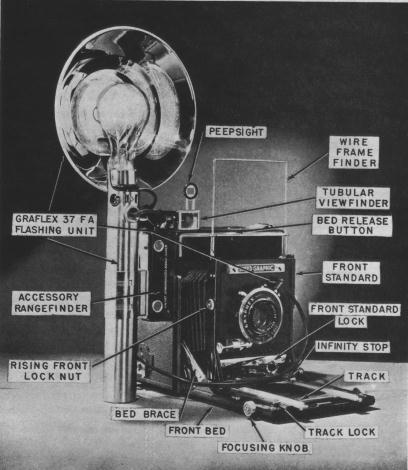
And what a camera! It was a Graflex Speed Graphic. It was a monster and had a million parts to learn, but it had a terrific lens and took great, large format photos. One of the teachers (I think it was an industrial arts teacher, but at any case, it was some male member of the faculty or staff) showed me the basics and told me to go for it. I lugged that monster almost everywhere for the next two years, using my best judgment about the aperture setting and shutter speed and usually coming out OK. It was really a matter of framing the scene within the wire frame finder and taking the picture, first on a plate and then later on a roll of film. Of course, everything was in black and white, but it really did a good job. Somewhere in 1964, the yearbook staff obtained a 35mm camera and the Speed Graphic headed for retirement. I wonder where it ended up.

Of course, one place I didn't lug around that camera was in sixth period PE. John Hines and I had run cross-country at Mac, but at RHS we could do anything and football was the thing.

The problem for me (and others) was that I had never played real tackle football before and didn't know anything. Tom McDougall had to show me how to put in my thigh pads the right way (if you didn't, you could hurt yourself in a way that would ensure you would never become a father).  I also didn't know how to get in a proper stance and Coach Mickler mocked me, saying I looked just like a frog. I guess I did, but I learned how to do it.

Coach Mickler probably couldn't believe the raw material he was stuck with, but he had a system. He asked all of us how fast we could run 50 yards. Since we had had to do this in PE at Mac, most of us knew. Coach Mickler then said anyone who could do it in 6 seconds flat or less was a back or end, anyone who took more than 6 seconds was a lineman.

So I became a back. But I could never come to rights with our quarterback, James Weaver, and could not take a handoff. After watching me fumble enough times, Coach Mickler said I was to become an end, and was assigned number 81, Naturally, as an end, my hands were still the same and I was not a threat to catch and run. However, in Coach Mickler's system, everyone played both ways and I guess I was tolerable on defense as a defensive end, even if I was hopeless on offense.

In our very first scrimmage with another team, in the open area behind the baseball field on H Street on the base, we scrimmaged with Schertz-Cibolo HS. Those fellows knew how to play. But we were willing to give it a go and hit as hard as we could, even if we couldn't really sustain an offense very well. At some time in the scrimmage, I was the right defensive end and Schertz ran a sweep at me. I could see what was happening, so I stepped up my 135 pounds of defensive end into the gap and was blocked across my thighs by some Schertz lineman. But he didn't knock me down, so as Concepcion Ramirez, the halfback, came through the hole, I reached over with my left arm and grabbed his shoulder pads near the neck and yanked him down. In pro football today, that kind of tackle is called a horse-collar and earns a 15 yard penalty. But in 1962, it was an acceptable thing to do.

Oh, yes, there was one more thing. I did yank Concepcion down, but his speed and my being anchored because of the blocker meant something had to give. And what gave was my left shoulder. It came completely out of socket and hurt like the devil. But I was able to shrug my shoulder and pop it back into socket, and stop the pain.

Coach Mickler, however, had to get me out of there and had the USAF doctor we had on the sideline check me over. He put me in a sling for a few days, but eventually pronounced me fit enough to play and I did, for the next two years.

Everyone involved here probably should have told me that was the end of my football career. I dislocated that shoulder again in 1962 at East Central, and in 1963, I dislocated it about four or five more times. But the time of my last game in November 1963, I had been fitted with the second of two heavy leather straps, one that went around my chest and another around my left bicep, and the two were connected by a chain. This was supposed to keep my shoulder close so it couldn't be pulled out of socket.

I said it was the second, because after one game with the first one, we discovered that I had ripped the chain out of one of the anchors and was just wearing a leather decoration on my arm.

In August of 1964, my shoulder was so shot that I had to have surgery on it over at Lackland. They did what they needed to do, and to this day I have less than full mobility in my left shoulder.

In an intelligent world, I should never have played after that first dislocation. But in the real world, I did, and have never regretted it. I don't think I would have matured as a person without having played football for two years for Coach Mickler and I thank my lucky stars for having had that opportunity.